
If your garage door isn’t opening smoothly, the springs might be the problem. Choosing the right garage door spring size isn’t just about fixing a squeak—it’s about safety, efficiency, and the life of your door. Using the wrong spring can damage your opener, wear out parts, and even be dangerous. But how do you find the correct size? This guide will help you understand the process step by step, even if you’re a beginner. We’ll break down the types of springs, the measurements you need, and what to do with your numbers. You’ll also see real examples, common mistakes, and answers to frequent questions.
Understanding Garage Door Springs
Before you start measuring, it’s important to know the two main types of garage door springs:
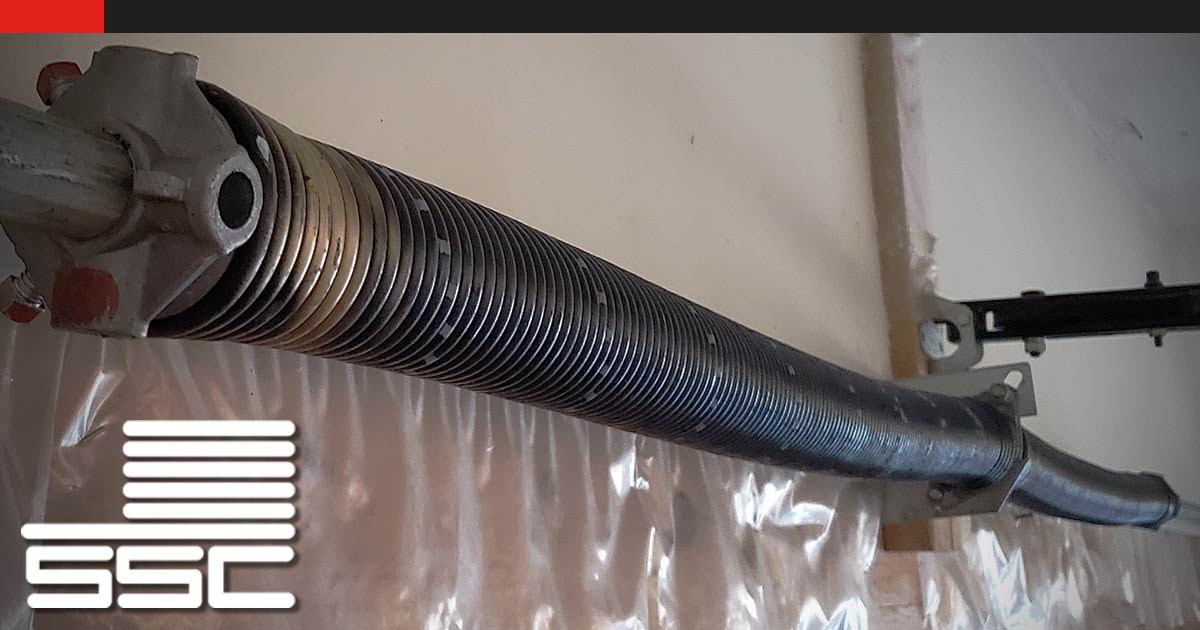
- Torsion springs: Sit above the door, parallel to the top. They twist to lift the door.
- Extension springs: Found on either side of the door, stretching when the door moves.
Most modern garage doors use torsion springs because they’re safer and last longer. However, many older or lighter doors still use extension springs.
Why Does Spring Size Matter?
The right spring size means:
- Balanced door movement
- Reduced wear on parts and opener
- Longer spring life
- Safer operation
If the spring is too strong, the door may not close fully. Too weak, and the opener works too hard or the door could fall.
What You’ll Need Before Measuring
Getting accurate measurements is simple with the right tools. Gather these before you start:
- Tape measure (preferably metal)
- Scale (for weighing the door if needed)
- Pen and paper or phone (for notes)
- Safety glasses and gloves (for protection)
Never remove a spring to measure it—it can be under high tension and cause injury.

Credit: duralifthardware.com
Key Measurements For Garage Door Springs
You need three numbers to determine the correct torsion spring size:
- Wire size
- Inside diameter
- Spring length
Let’s look at each.
Measuring Wire Size
Wire size is the thickness of the spring coil. You can’t just measure one coil; instead, count a set number of coils and measure that length.
How to measure:
- Pick 10 or 20 coils on the spring.
- Measure from one end of the 10th (or 20th) coil to the other.
- Divide by the number of coils.
Example:
- 10 coils measure 2 inches. Wire size = 2 ÷ 10 = 0.200 inches.
Here’s a quick reference for common wire sizes:
| 10-Coil Length (inches) | Wire Size (inches) |
|---|---|
| 1.75 | 0.177 |
| 2.00 | 0.200 |
| 2.25 | 0.225 |
| 2.50 | 0.250 |
A digital caliper can make this easier, but a regular tape measure works for most people.
Measuring Inside Diameter
The inside diameter is the open space inside the spring. Most residential torsion springs are:
- 1.75 inches
- 2.00 inches
Check for a stamp or sticker at the winding cone (metal piece at the end). If not, measure across the inner width of the spring.
Measuring Spring Length
Length affects how much the spring can stretch and the door’s balance.
- Measure the entire coil portion, not the cones.
- Remove any loose or broken pieces from the ends.
- If the spring is broken in two, measure both pieces and add together.
Tip: Do not stretch or compress the spring while measuring.
Determining Spring Wind
Torsion springs are wound in one direction:
- Right-wound: Usually for left side of the door (when inside the garage).
- Left-wound: Usually for right side.
Look at the last coil at the end—if it points up and to the right, it’s right-wound. Most residential doors use one of each.
How To Calculate The Correct Spring Size
Once you have wire size, inside diameter, and spring length, you can find the correct spring. But there’s one more step: the door’s weight.
Weighing The Garage Door
If you don’t know the weight, follow these steps:
- Disconnect the opener (pull the release cord).
- With the door closed, lift slowly by hand.
- If the springs are broken, the door will be heavy—use a bathroom scale under the center.
- Record the weight.
Typical residential garage doors weigh between 90–350 pounds.
Using Measurements To Select A Spring
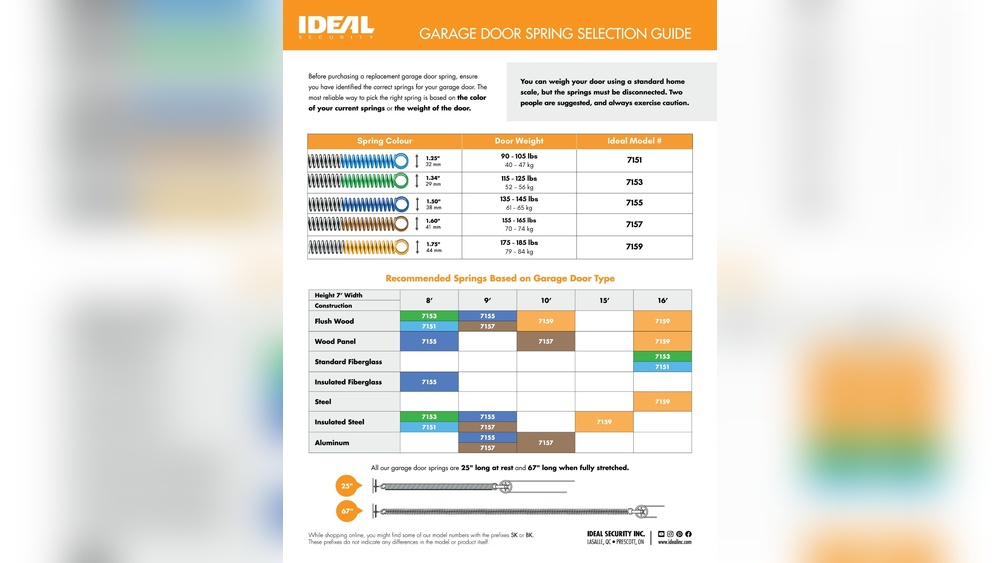
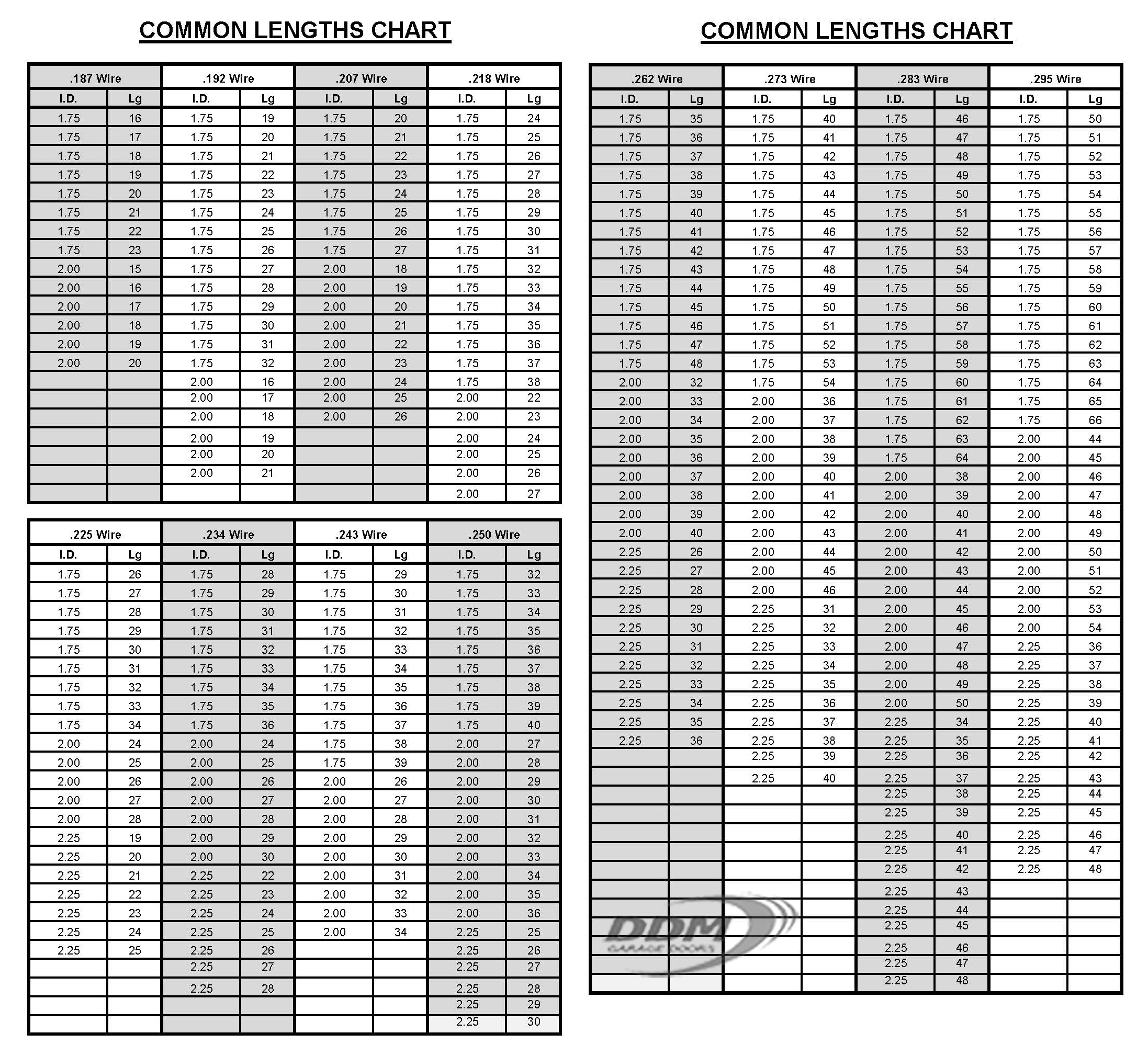
Match your numbers to a spring chart from a manufacturer or supplier. Most charts look like this:
| Door Weight (lbs) | Wire Size (inches) | Inside Diameter (inches) | Spring Length (inches) |
|---|---|---|---|
| 120 | 0.207 | 1.75 | 23 |
| 150 | 0.218 | 1.75 | 24 |
| 200 | 0.225 | 2.00 | 28 |
Tip: If your measurements don’t match a chart, contact the spring supplier for help.
Extension Springs: What’s Different?
Extension springs use different measurement steps:
- Measure the length of the spring (not stretched).
- Measure the overall coil diameter.
- Check the wire size (same method as torsion).
- Note the end type (open loop, double loop, clipped).
Extension springs are rated for door weight. Choose a spring based on the exact weight of your door, not just its size.
Real-world Example
Let’s walk through a practical example for a standard double garage door:
- You measure 10 coils at 2 inches: Wire size = 0.200 inches.
- Inside diameter = 2.00 inches.
- Length = 23 inches.
- Door weight (using scale): 180 pounds.
Using a supplier chart, you find:
- The spring needed is 0.200 wire size, 2.00-inch inside diameter, and 23-inch length, suitable for a door around 180 pounds.
If your numbers don’t match exactly, always round up to the stronger spring—but not too much, or the door will be hard to close.
Common Mistakes To Avoid
Even small errors can cause big problems with your garage door. Beginners often make these mistakes:
- Measuring the wrong coils: Always count and measure at least 10 coils.
- Guessing the door weight: Don’t estimate; weigh it for accuracy.
- Ignoring inside diameter: This affects the fit on the shaft.
- Not checking both springs: Many doors have two springs—measure both in case they’re different.
- Confusing spring types: Torsion and extension springs are not interchangeable.
Non-obvious insight: Springs lose strength slowly over time. If your door is suddenly heavy, both springs may need replacement—even if only one broke.
Credit: www.servicespring.com
Safety Tips For Measuring And Replacing Springs
Garage door springs are under tension. Even measuring can be risky if you’re not careful. Always:
- Wear safety glasses and work gloves.
- Never loosen set screws or unbolt a spring without proper tools and knowledge.
- If unsure, call a professional.
Pro tip: Take a picture of your current setup before removing anything. It helps when installing new springs.
When To Call A Professional
Not every repair is DIY. Call a garage door technician if:
- The spring is hard to access or identify.
- You’re unsure of your measurements.
- The spring is unusually large or for commercial use.
A pro can also balance and test the door, ensuring it works smoothly and safely.
Credit: ddmgaragedoors.com
Resources For More Information
If you need more technical charts or want to verify your work, check the official Door & Access Systems Manufacturers Association guidelines. These contain in-depth charts and safety tips. A reliable resource is the Garage Door Opener Wikipedia page.
Frequently Asked Questions
What Happens If I Install The Wrong Garage Door Spring Size?
Using the wrong size can:
- Make the door unbalanced
- Damage the opener
- Cause safety risks, like the door slamming shut
Always match the spring to your measurements.
Can I Measure The Spring While It’s Still Installed?
Yes, you can measure most springs while installed. Just measure the coil portion and avoid the end cones. For extension springs, measure when the door is fully closed.
How Do I Know If My Door Uses Torsion Or Extension Springs?
- Torsion springs: Mounted above the closed door, parallel to the header.
- Extension springs: Run along the sides, above the horizontal tracks.
Look for the spring’s position and shape.
Do I Need To Replace Both Springs At The Same Time?
It’s best to replace both if your door uses two. If one broke, the other is likely worn too. Replacing both keeps door balance and extends life.
Is It Safe To Replace Garage Door Springs Myself?
Replacing springs can be dangerous due to high tension. If you’re not confident, or if the spring is heavy-duty, hire a professional. Safety always comes first.
Finding the right garage door spring size is not just about numbers—it’s about making your home safer and your door last longer. With the steps and tips above, even beginners can make smart choices. If you’re ever unsure, don’t risk it—call a pro. A well-chosen spring means years of reliable, quiet operation for your garage door.