
How Much Change Should I Have For A Garage Sale
Hosting a garage sale can be an exciting way to declutter your home and earn some extra cash. But many sellers overlook one simple detail: having enough change on hand. Imagine losing a sale because you can’t break a $20 bill. For beginners, it’s not always clear how much change to prepare, what bills and coins you need, or how to handle cash flow during a busy sale. This guide will walk you through the practical steps and real numbers you need, so your garage sale runs smoothly and you keep happy customers.
Why Having Enough Change Is Essential
When your garage sale starts, expect people to pay with larger bills. Early shoppers often arrive with $20 or $10 bills. If you can’t give proper change, you might lose sales or frustrate buyers. Having enough change means:
- You never turn away a customer for lack of small bills.
- Transactions go faster.
- You appear more organized and trustworthy.
Even a small garage sale can handle dozens of transactions. Without enough small bills and coins, things can get complicated quickly.
How Much Change Should You Start With?
The right amount of change depends on your expected sales volume and your pricing. For most garage sales, $80 to $120 in change is a smart starting point. Here’s a practical starting setup for a typical one-day sale:
- $40 in $1 bills (forty $1 bills)
- $20 in $5 bills (four $5 bills)
- $20 in $10 bills (two $10 bills)
- $10 in quarters (forty quarters)
- $5 in dimes (fifty dimes)
- $5 in nickels (one hundred nickels)
That totals $100 in change. If you expect a lot of sales, raise this to $120-$150 by adding more $1 and $5 bills.
Sample Change Breakdown
| Denomination | Quantity | Total Value |
|---|---|---|
| $1 bills | 40 | $40 |
| $5 bills | 4 | $20 |
| $10 bills | 2 | $20 |
| Quarters | 40 | $10 |
| Dimes | 50 | $5 |
| Nickels | 100 | $5 |
This setup covers most basic transactions and allows you to give correct change for almost any small purchase.

Credit: deceptivelyeducational.blogspot.com
Factors That Influence Your Change Needs
Every garage sale is different. Consider these factors when deciding your change amount:
- Pricing strategy: If most items are $1, you need more $1 bills and quarters.
- Total number of items: More items mean more transactions and more need for change.
- Expected crowd size: Bigger crowds require more initial change.
- Sale hours: Longer sales may need more change, especially in the morning.
- Your neighborhood: In some areas, buyers bring small bills; in others, only $20s.
Example Scenarios
| Sale Type | Recommended Change | Key Denominations |
|---|---|---|
| Small Sale (under 50 items) | $60–$80 | $1s, $5s, quarters |
| Medium Sale (50–150 items) | $100–$120 | $1s, $5s, $10s, quarters |
| Large Sale (over 150 items) | $120–$150 | $1s, $5s, $10s, coins |
If you plan to sell larger items (like furniture), keep a few $10 bills. For mostly small, low-priced items, focus on $1s and coins.
What Denominations To Have
Most garage sale items are priced under $5. You’ll need plenty of small bills and coins. Here’s a practical guide:
- $1 bills: These are the workhorses. Have more $1s than anything else.
- $5 bills: For change when buyers pay with $10s or $20s.
- $10 bills: You don’t need many—just enough for larger purchases.
- Quarters: Useful for 25¢ or 75¢ items and for making up odd cents.
- Dimes and nickels: Have a small roll of each, especially if you price items at 10¢ or 15¢.
- Pennies: Only if you have items priced at 1¢ or prices ending in .01 or .99.
Sample Denomination List
- 40 x $1 bills
- 8 x $5 bills
- 2 x $10 bills
- 40 x quarters
- 50 x dimes
- 100 x nickels
Avoid having large bills ($20s, $50s) in your change box. You won’t need them for giving change, and they pose a security risk.
How To Get Change For Your Garage Sale
Most banks are used to requests for small bills and coins. Here’s how to prepare:
- Visit your bank a few days before your sale.
- Ask for new, crisp bills and rolled coins if possible.
- Tell the teller you’re hosting a garage sale—they may have suggestions.
- Double-check your change before leaving the bank.
If you don’t have a bank account, some grocery stores or credit unions will break larger bills for you. Avoid using change machines at supermarkets—they often charge fees.
Tips For Handling Cash During Your Sale
Managing cash during a busy garage sale can be stressful. Keep these tips in mind to avoid common mistakes:
- Use a cash box or apron: A lockable cash box is safest, but a waist apron keeps cash with you at all times.
- Organize by denomination: Keep bills and coins in separate sections for quick access.
- Remove excess cash: When your box starts to fill up, move large bills inside your house or a safe place.
- Have a calculator handy: For quick math and to avoid mistakes.
- Use a receipt pad: For big-ticket items, write receipts to document sales.

Credit: www.simplisticallyliving.com
Pricing Items For Easy Change
One beginner mistake is pricing items at odd numbers, like 65¢ or $1.35. To make change easier:
- Price items in round numbers: $1, $2, 50¢, etc.
- Group similar items together for bulk deals (e.g., “5 books for $5”).
- Avoid prices that require pennies unless you’re well-stocked.
This strategy means you need fewer coins and makes transactions faster.
Example: Simplified Pricing
| Item | Suggested Price | Change Needed |
|---|---|---|
| Paperback books | $1 each | $1 bills |
| Children’s clothes | 50¢ each | Quarters |
| Toys | $2 each | $1, $5 bills |
| Kitchen items | $3 each | $1, $5 bills |
With simple pricing, your need for small coins drops, and buyers can pay with almost any bill.
Handling Large Bills From Buyers
Sometimes, a buyer only has a $20 bill for a $2 item. Here’s how to handle it:
- Check your cash supply: If you can’t break the bill, politely ask if the buyer has smaller bills.
- Suggest additional purchases: “If you find more items, I can break a $20.”
- Set a policy: Put up a sign: “Please use small bills when possible.”
Be cautious about accepting $50 or $100 bills, as they’re often counterfeit targets. If you do accept them, check for security features.
Common Mistakes And How To Avoid Them
- Not having enough $1 bills: Most common mistake. Always have more than you think you’ll need.
- Ignoring coins: Quarters are crucial for items under $1.
- Pricing items with odd cents: Leads to confusion and slows transactions.
- Leaving the cash box unattended: Always keep cash secure.
- Not removing large bills from the sales area: Don’t let your cash box overflow.
Non-obvious Insights For Beginners
- Early shoppers will test your change supply: Be most prepared at the start, not the end, of your sale.
- Keep a notepad: Track how much change you start with and how much you end with. This helps you spot errors or missing cash.
- Have a backup plan: Ask a friend or neighbor to bring extra small bills just in case you run out.
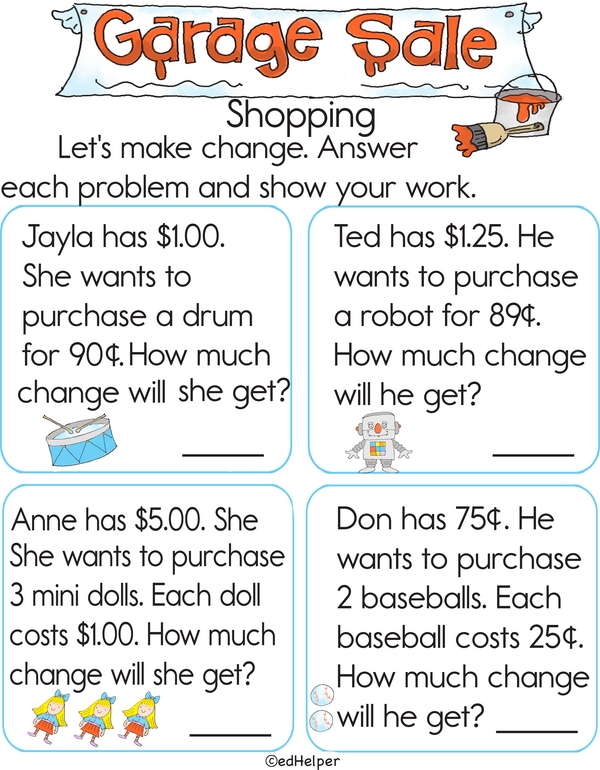
Credit: worksheets.edhelper.com
Practical Example: Planning For A $200 Sale
Let’s say you expect to sell about $200 of items, most priced at $1–$5 each. Here’s a safe change setup:
- $60 in $1 bills
- $40 in $5 bills
- $10 in $10 bills
- $20 in quarters
- $10 in dimes
This $140 starting change will cover most situations, even if several buyers pay with $20 bills early on.
Digital Payments And Change
Today, some buyers prefer paying with apps like Venmo or PayPal. Offering digital payment options can:
- Reduce your need for small change.
- Make transactions faster for tech-savvy buyers.
- Help you avoid running out of bills or coins.
However, always post clear signs about accepted payment methods. Not everyone will use digital options, so cash change is still necessary.
For more about safe garage sale practices, check the tips at Consumer FTC.
Frequently Asked Questions
How Much Change Should I Start With For A Small Garage Sale?
For a small sale (under 50 items), start with $60–$80 in change. Focus on $1 bills and quarters, since most items will be priced low.
Can I Refuse Large Bills At My Garage Sale?
Yes. You can politely refuse $50 or $100 bills, especially if you can’t make change. Post a sign: “No bills over $20, please.”
What If I Run Out Of Change During The Sale?
Ask a friend or neighbor for extra bills, or take a quick trip to a nearby store to break a large bill. Always have a backup plan for more change.
Do I Need To Accept Coins Like Pennies?
Not usually. If your prices are in whole dollars or 25¢ increments, you won’t need pennies. Only stock them if you use prices like 99¢.
Should I Offer Digital Payment Options?
Offering payment apps like Venmo or PayPal can help, but don’t skip cash. Not every buyer uses digital apps, so always have enough change on hand.
—
Having the right amount and types of change is a small detail that makes a big difference at your garage sale. With proper planning, organized cash, and smart pricing, you’ll create a stress-free experience for yourself and your buyers. Start with more small bills than you think you need, simplify your pricing, and always be prepared for the unexpected.
That’s how you’ll turn your clutter into cash—one smooth transaction at a time.