Air tools are often lighter and useful for demanding, repeated work in a well-equipped workshop. Electric tools are usually easier to set up, more portable, and more practical for most home projects. The best choice depends on your workload, power needs, budget, and work location.
In a United States home garage, automotive repair shop, woodworking space, or construction jobsite, choosing the right power tool can save time and reduce extra costs. Both air-powered and electric tools can handle many common jobs. However, they use different power sources and need different equipment to work well.
Air tools, also called pneumatic tools, run on compressed air from an air compressor. Electric tools use power from a wall outlet or a rechargeable battery. This basic difference affects their weight, setup, cost, mobility, maintenance, and daily use.
The choice is not as simple as saying that air tools are more powerful or electric tools are more convenient. Modern cordless tools can offer strong performance, while pneumatic tools can be useful for long periods of repeated work. A good choice starts with the actual job and the tool specifications.
This guide explains the main differences, shows how to size an air compressor, and covers the safety and maintenance needs of both types. It also explains when buying both types makes practical sense.
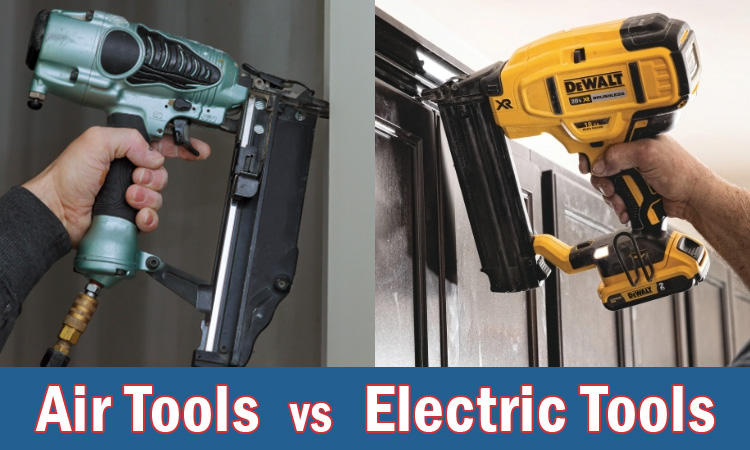
Source: metrosales.co.uk
What Are Air Tools and Electric Tools?
Air tools use compressed air to make their internal parts move. An air compressor pulls in air, compresses it, and stores it in a tank. A hose then carries that air to the tool. Common examples include pneumatic impact wrenches, nail guns, spray guns, air ratchets, and die grinders.
Electric tools use an electric motor to create movement. The motor receives power from a cord or a rechargeable battery. Common examples include electric drills, impact drivers, grinders, saws, sanders, and impact wrenches.
There is one useful detail to understand before comparing the two. An air tool is not always powered by a gas engine. Many air compressors in American garages use electricity. The difference is that compressed air drives the handheld tool, while an electric motor drives an electric tool directly.
Electric tools also have two distinct types. Corded tools connect to an electrical outlet. Cordless tools use rechargeable battery packs. These two types have different benefits, so treating all electric tools as one group can lead to a poor buying decision.
Air-powered tools
Use compressed air delivered through a hose. They depend on compressor pressure, airflow, and suitable fittings.
Corded electric tools
Connect to a power outlet and do not depend on a rechargeable battery. Their mobility is limited by the cord and available electrical supply.
Cordless electric tools
Use rechargeable batteries. They are easy to move around a garage, driveway, workshop, or jobsite.
What Does Pneumatic Mean?
Pneumatic means operated by compressed air or gas. In the tool industry, the term usually describes equipment powered by compressed air. Pneumatic tools need enough pressure and airflow to work as intended.
A tool may have a pressure requirement listed in pounds per square inch, or PSI. It may also list air consumption in standard cubic feet per minute, or SCFM. Both figures matter when choosing the compressor.
Air Tools vs Electric Tools: Main Differences
The biggest difference is how each tool gets power. However, the effects reach far beyond the power source. Weight, mobility, purchase cost, setup time, maintenance, and the type of work all affect the final choice.
Air tools can be a good fit for shops that already have a compressor and use several pneumatic tools. A single compressor can supply air to compatible equipment through a suitable distribution setup. This can reduce the need to buy separate motors and power systems for every tool.
Electric tools are often a simpler choice for people who own only a few tools. A cordless drill, for example, needs a charged battery rather than an air compressor and hose. A corded sander needs a suitable outlet rather than an air supply.
The following comparison gives a useful starting point. Actual tool designs and model specifications can change the result.
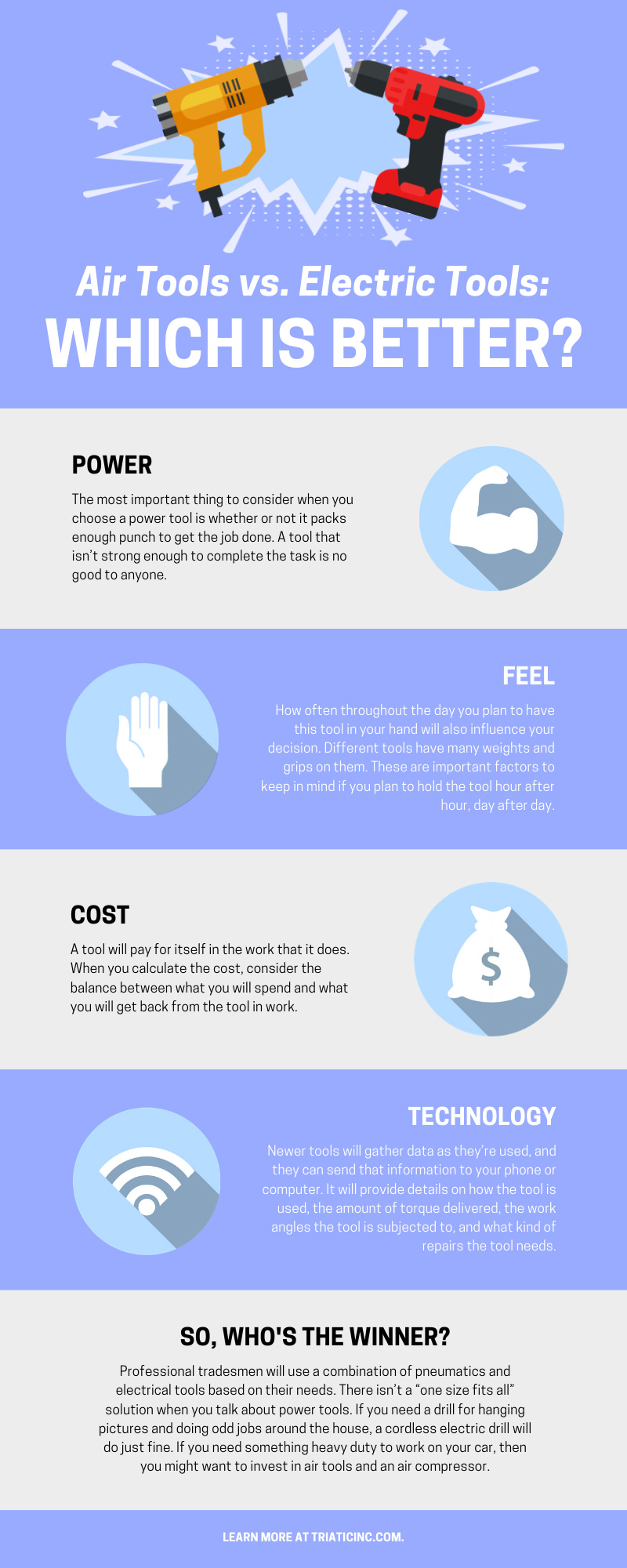
Source: storage.googleapis.com
Power source
Air tools use compressed air. Electric tools use a wall outlet or rechargeable battery.
Setup
Air tools need an operating compressor, air hose, and suitable fittings. Electric tools usually need only a compatible outlet or charged battery.
Weight
Many pneumatic models are light because they do not contain a large electric motor or battery. However, hose weight and the tool’s design still matter.
Mobility
Cordless tools are easy to move. Air tools depend on hose reach and compressor placement. Corded tools depend on outlet access.
Continuous use
Pneumatic tools can work for repeated cycles when the compressor can maintain the required airflow. Corded tools can also provide continuous power when properly supplied. Cordless tools need battery changes or charging.
Maintenance
Air tools may need lubrication, moisture control, and hose inspections. Electric tools need battery, cord, motor, and accessory care as specified by the manufacturer.
Initial cost
A pneumatic tool may cost less by itself, but the compressor and air accessories add to the starting cost. Electric tools can require less equipment at the beginning.
Which Type Is Easier to Use?
Electric tools are usually easier for beginners because they need less setup. You can connect a corded tool or insert a charged battery and begin working. This is useful for repairs that take only a few minutes.
Air tools are not difficult to operate, but their supporting equipment needs attention. Users must understand pressure settings, hose connections, compressor limits, and moisture control. Once the air system is ready, changing between compatible tools can be quick.
Power and Performance: Which Type Is Stronger?
Neither air tools nor electric tools are always stronger. Their performance depends on the specific tool, its design, its power supply, and the work being done. Some pneumatic tools deliver strong output in a compact body, while modern cordless tools can provide comparable performance in many applications.
This is especially clear with impact wrenches. A pneumatic impact wrench can be a strong choice for a busy automotive shop that already owns a compressor. A modern cordless impact wrench may be more practical for a mobile mechanic or a home user who needs to work in different places.
Do not judge a tool by a large number printed on its box alone. For impact wrenches, check the type of torque rating, such as fastening torque or breakaway torque. These describe different operating conditions and should not be treated as identical measurements.
For drills and grinders, compare speed, power rating, workload limits, and manufacturer guidance. For nailers, compare compatible fasteners, operating pressure, and firing requirements. The best tool is the one that can complete your actual work without being pushed beyond its rated capacity.
Choose air tools for repeated shop work
They can suit professional repair shops and production spaces where a correctly sized compressor supports several tools.
Choose corded tools for steady power
They can work well for long tasks in places with a suitable electrical outlet and safe cord routing.
Choose cordless tools for mobile jobs
They offer useful performance without an air hose or a constant connection to an outlet.
Can Cordless Tools Match Air Tools?
Yes, cordless tools can match or even exceed some pneumatic models in particular applications. Modern battery systems and motor designs have improved the performance of many drills, drivers, and impact wrenches.
However, this does not mean every cordless model can replace every air tool. Compare the exact tool models, workload, battery capacity, operating limits, and performance ratings. A strong cordless impact wrench may be useful for vehicle repairs, while a high-demand production task may still benefit from an established pneumatic setup.
Cost Comparison: Which Is More Affordable?
Electric tools are often cheaper to start using because many jobs require only the tool itself, a battery and charger, or a suitable power outlet. This makes them attractive to homeowners, DIY users, and people who use tools from time to time.
Air tools can have a lower individual tool price, but the full setup can cost more at the beginning. A working system may need an air compressor, hose, couplers, regulator, filters, moisture control, and other accessories. These costs matter even when the pneumatic tool looks inexpensive.
The calculation changes when a shop already owns a suitable compressor. In that case, buying another compatible air tool may be a reasonable investment. The compressor and air distribution system can support several tools, provided the system has enough capacity and the equipment is compatible.
Long-term costs also matter. An air compressor uses energy and may need servicing. Hoses and fittings can wear or leak. Batteries eventually lose capacity, and replacement packs can add to the cost of electric tools. Neither category has a guaranteed lower lifetime cost.
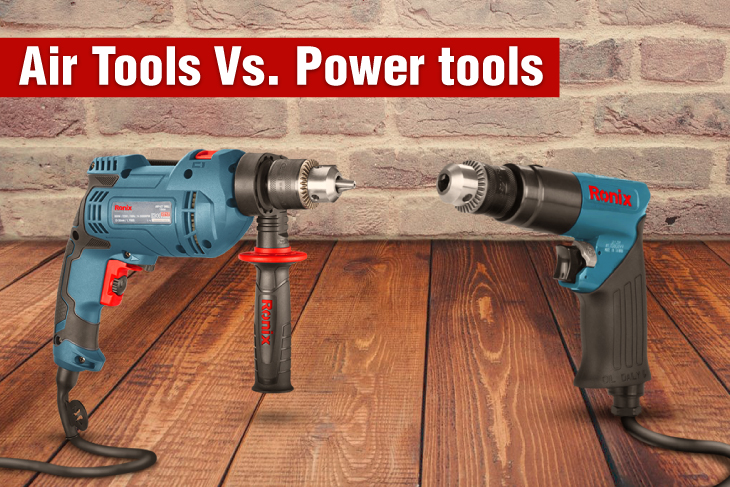
Source: ronixtools.com
Pneumatic purchase costs
Include the tool, compressor if needed, hoses, fittings, regulator, filtration, and any required lubrication equipment.
Corded electric purchase costs
Include the tool, compatible accessories, and any required electrical supply or suitable extension cord.
Cordless electric purchase costs
Include the tool, compatible battery packs, charger, and any replacement batteries needed over time.
How to Compare Total Ownership Costs
Start with the complete price of a working setup rather than the tool’s advertised price. Then consider how often you will use it and what supporting equipment you already own.
For example, a garage that already has a compressor may only need a new hose and pneumatic impact wrench. A homeowner who owns no air equipment may need to purchase several items before that same wrench can work.
A cordless electric model may have a higher tool price, but it can avoid the need for a compressor and air line. This can make it the more affordable option for occasional repairs.
Compare the starting cost
Add every item needed to make the tool usable.
Compare ongoing costs
Consider electricity, replacement batteries, compressor maintenance, hoses, and repair parts.
Consider usage frequency
A system used every day may justify equipment that would be unnecessary for occasional home repairs.
How to Choose the Right Air Compressor
Choosing the right compressor is one of the most important steps when buying pneumatic tools. A compressor that cannot supply enough air may allow a tool to start but fail to maintain its performance during repeated use.
Two specifications matter most at the beginning. PSI describes pressure, while SCFM describes the volume of air delivered over time under standard conditions. A pneumatic tool needs enough of both to operate as intended.
Tank capacity also matters, but it does not tell the whole story. A larger tank stores more compressed air, which can help with short bursts of work. The compressor pump must still produce enough air to meet the tool’s ongoing demand.
Always check the exact tool manual or manufacturer specification before purchasing a compressor. Air requirements vary between models, even when the tools have similar names.
Source: fixtectools.com
Check PSI
Find the recommended operating pressure for the exact tool. Do not exceed its maximum rated pressure.
Check SCFM
Find the tool’s air consumption requirement and compare it with the compressor’s delivered airflow at the same pressure.
Check tank capacity
Consider whether the tool uses short bursts or needs a steady supply of air.
Check duty cycle
Make sure the compressor can handle the expected running time without exceeding its operating limits.
Check hose requirements
Use suitable hose diameter, fittings, filters, and regulators to avoid unnecessary pressure loss.
What Is SCFM and Why Does It Matter?
SCFM stands for Standard Cubic Feet per Minute. It describes the rate at which air is supplied under defined standard conditions. In simple terms, it helps you understand how much air a tool needs to keep working.
PSI and SCFM measure different things. A compressor may reach a high pressure but still deliver too little airflow for a demanding tool. That is why checking only the maximum PSI or the tank size can lead to a poor purchase.
For a useful comparison, check the compressor’s delivered SCFM at the tool’s required operating pressure. Do not compare a compressor’s airflow rating at one pressure with a tool’s requirement at another pressure without checking the specifications.
A Simple Compressor Sizing Example
Imagine that an air tool requires 5 SCFM at 90 PSI. The compressor must be capable of delivering enough airflow at that pressure for the expected workload.
As one retail buying guideline, The Home Depot suggests using 1.5 times the highest tool SCFM rating as an initial compressor-sizing allowance. Applying that example gives 7.5 SCFM at 90 PSI. This is a screening example, not a universal engineering rule or a substitute for the manufacturer’s requirements.
If you plan to run several tools at the same time, account for their combined demand. Also consider the compressor’s duty cycle and the amount of air used during the work. A compressor that supplies a tool only in short bursts may not support continuous sanding or grinding.
Step 1
Read the tool manual and write down its required PSI and SCFM.
Step 2
Check the compressor’s actual airflow rating at the required PSI.
Step 3
Account for other tools that may run at the same time.
Step 4
Check the tank, pump capacity, and duty cycle for the planned workload.
Step 5
Confirm that the hose and fittings can supply the required airflow without excessive pressure loss.
Does a Bigger Tank Always Mean a Better Compressor?
No. A bigger tank does not automatically make a compressor suitable for every air tool. It gives the system more stored air, but the pump still needs to refill the tank at a rate that matches the demand.
Small tanks may be suitable for tools that use short bursts of air. Tools that run continuously may need a compressor with much higher airflow and suitable cooling capacity. A good compressor matches both the tool and the expected working time.
Portability and Ease of Movement
Cordless electric tools are generally the easiest to move from one work area to another. They do not need an air hose or a nearby power outlet. This makes them useful for mobile mechanics, contractors, homeowners, and outdoor projects.
Air tools depend on the compressor and hose. A fixed workshop with a properly designed air line can make this arrangement convenient. However, moving an air tool far from the compressor may require a longer hose, suitable fittings, and attention to pressure loss.
Corded electric tools depend on electrical outlets and cords. They work well when the job stays near a suitable power source. Extension cords can help in some situations, but their rating, condition, and suitability for the tool must be checked.
Weight also affects mobility. Some air tools are lighter than comparable electric models, but the hose can pull against the user’s hand or catch on nearby objects. Cordless tools may be heavier because of their batteries, yet they offer freedom from hoses and cables.
For a home garage
Cordless tools are convenient for moving between vehicles and storage areas.
For a fixed repair shop
A suitable compressed-air distribution system can make pneumatic tools practical for repeated work.
For outdoor construction
Cordless models can reduce the need to manage long power cords or air hoses.
For stationary workshop tasks
Corded tools may be useful when consistent electrical power is available and movement is limited.
Which Tool Is Better for Tight Spaces?
The answer depends on the tool’s physical shape, handle design, head length, and hose or battery placement. Some compact pneumatic tools fit into narrow automotive spaces. Some electric models have shorter heads or better access around obstacles.
Compare the actual dimensions before buying. A smaller tool body does not always guarantee better access if its hose connector or battery blocks the area where you need to work.
Maintenance and Expected Tool Life
Air tools need regular attention to their air supply. Dirt, moisture, poor lubrication, and incorrect pressure can affect performance and cause wear. Hoses and fittings also need regular inspection.
Electric tools usually have a simpler setup because they do not need an air system. However, they still require care. Battery contacts, chargers, cords, switches, vents, and moving parts can wear or become damaged.
Neither type has a guaranteed lifespan. Quality, working conditions, workload, storage, and maintenance all influence how long a tool remains useful. A cheap tool that receives heavy daily use may wear out sooner than a suitable professional model.
Follow the instruction manual for each tool. Some pneumatic tools require regular oiling, while others have different lubrication systems. Do not assume that every air tool needs the same oil or that every electric tool needs the same cleaning method.
Source: storage.googleapis.com
Inspect air hoses
Look for cracks, worn fittings, loose connections, and visible damage before using the system.
Control moisture
Drain compressor tanks and maintain filters or moisture separators as directed by the manufacturer.
Lubricate when required
Use only the recommended lubricant and amount for tools that require oil.
Inspect electrical cords
Remove damaged tools and cords from service rather than trying to work around exposed wires or broken plugs.
Care for batteries
Use the correct charger and follow the manufacturer’s storage and temperature guidance.
Why Does Moisture Damage Air Tools?
Compressed air can contain water vapor. As the air cools, moisture can collect in the compressor tank and air lines. That moisture may contribute to corrosion, poor operation, or premature wear in pneumatic equipment.
A suitable filter, separator, or air dryer may help control moisture, depending on the application. The compressor tank should also be drained according to its manual. Moisture control is especially important for painting and other tasks where water or contamination can damage the result.
Which Type Lasts Longer?
There is no reliable rule that all pneumatic tools last longer than electric tools. Pneumatic designs can have fewer electrical components in the handheld tool, but they still contain moving parts and depend on clean, correctly regulated air.
Electric tools avoid compressor maintenance, but their motors, switches, electronics, and battery packs can require repair or replacement. The most useful comparison is the service information and warranty for the exact models you are considering.
Air Tools vs Electric Tools: Safety Differences
Both tool categories can cause injuries when they are used incorrectly. The hazards differ, but neither type should be treated as automatically safe. Always read the manual, inspect equipment, and use the correct protective gear.
Electric tools can create shock and fire hazards when cords, plugs, or electrical components are damaged. Wet work areas can create extra risks. OSHA advises that electric tools should not be used in damp or wet locations unless they are approved for that purpose.
Air tools have their own hazards. A disconnected hose can move unexpectedly, compressed air can forcefully eject debris, and excessive pressure can damage equipment. High-pressure air should never be treated as harmless just because it is not ordinary electrical power.
The United States OSHA construction standard 29 CFR 1926.302 includes requirements for pneumatic hose connections, impact tool retainers, safe pressure limits, and restrictions on compressed-air cleaning. These are construction workplace requirements, not a replacement for the manual or every rule that may apply to other settings.
Wear eye protection
Use suitable safety glasses or goggles to protect against flying particles and debris.
Protect your hearing
Use suitable hearing protection when noise levels and exposure time create a risk.
Secure air connections
Use the correct fittings and positive hose-retention methods. Inspect connections before applying pressure.
Respect rated pressure
Never exceed the pressure limits of the tool, hose, fittings, or compressor.
Inspect electrical equipment
Check cords, plugs, and tool housings. Use appropriate electrical protection, including GFCI protection where required.
Keep work areas clear
Arrange hoses and cables to reduce trips, tangles, and accidental disconnections.
Noise and Hearing Protection
Noise is a risk with both air and electric tools. An air compressor can add to the noise produced by the tool itself. Electric impact tools, grinders, and saws can also create high sound levels.
NIOSH recommends an occupational noise exposure limit of 85 dBA averaged over an eight-hour workday. It also advises reducing exposure time as noise levels increase. This is a recommended occupational exposure limit, not a claim that every tool produces the same noise level.
Use suitable hearing protection and check the actual noise information for the equipment. Do not assume that an air tool is quieter than an electric tool without reliable measurements.
Can You Use Air Tools Around Water?
Do not assume that pneumatic tools are safe for every wet or hazardous area. The handheld pneumatic tool may use compressed air, but the compressor may still use an electric motor, and its electrical supply needs suitable protection.
Compressed-air equipment also has pressure-related hazards. Choose equipment specifically approved for the working environment and follow the applicable safety requirements. For electrical work or wet-location work, seek qualified guidance rather than relying on the power source alone.
Safe Compressed-Air Cleaning
Never point a compressed-air nozzle at yourself or another person. Compressed air can propel particles at dangerous speeds and can cause serious injuries.
For construction workplaces covered by OSHA 29 CFR 1926.302, compressed air used for cleaning must be reduced below 30 PSI and used with effective chip guarding and suitable personal protective equipment, subject to the standard’s stated exceptions. Always check the applicable workplace rules and equipment instructions before using compressed air for cleaning.
Which Jobs Are Best for Air Tools?
Air tools are particularly useful when a workshop already has a suitable compressor and several pneumatic tasks to complete. Automotive repair, repeated fastening, certain sanding tasks, and suitable spraying jobs can benefit from a well-planned compressed-air system.
Their compact designs can also help in some repair situations. A lightweight pneumatic ratchet or grinder may be comfortable during repeated work, depending on the model and hose arrangement.
However, the compressor must support the required airflow. A small compressor that works well for a nail gun may be unsuitable for a tool that consumes much more air. Always match equipment to the task rather than purchasing a compressor based only on its tank size.
Automotive repair
Pneumatic impact wrenches and ratchets can be useful in a garage with an adequate compressed-air supply.
Workshop fastening
Air nailers and staplers can support repeated fastening work when matched with the correct air supply.
Selected grinding and sanding jobs
Air-powered models can suit production or repair work when their airflow needs can be met.
Compatible spray applications
Pneumatic spray equipment can provide useful control, but requires suitable airflow, filtration, and moisture control.
Are Air Tools Good for Automotive Work?
Yes. Pneumatic tools have a long-standing place in automotive repair shops. They can support repeated bolt removal, fastening, grinding, and other suitable repair tasks.
A shop must still size its compressor correctly. Several tools may be used throughout the day, and the total air demand can be much higher than the demand from one small tool. Hose layout and pressure regulation also affect performance.
Which Jobs Are Best for Electric Tools?
Electric tools are useful for home improvement, furniture assembly, general maintenance, construction, and mobile repair. Their simple setup makes them appealing when a compressor is not already available.
Cordless drills and impact drivers are common choices for quick fastening work. Corded saws and sanders can suit longer tasks where a stable electrical supply is available. Battery-powered models can also help contractors move around large work areas without managing an air hose.
For many homeowners, a small collection of electric tools is enough. A drill, impact driver, circular saw, and sander can cover a wide range of common jobs. The best tool combination depends on the material, cutting or fastening task, and how often each item will be used.
Home improvement
Electric drills, drivers, and saws are practical for household repairs and installation projects.
Furniture assembly
Cordless drills and drivers allow easy movement around furniture and work areas.
Mobile repair
Cordless tools avoid the need to transport a compressor or connect to an electrical outlet at every location.
Long stationary tasks
Corded tools can be useful when a suitable power source is available and battery changes would interrupt the work.
Are Corded Tools Better Than Cordless Tools?
Corded tools can be a better choice for some long jobs because they do not rely on a battery charge. They can also avoid the ongoing cost of buying extra battery packs.
Cordless tools offer greater mobility and can reduce the number of cables around a workspace. However, runtime depends on battery capacity, workload, temperature, and the condition of the battery.
The best option depends on your work area. Choose corded equipment when stable power and longer operation matter more than mobility. Choose cordless equipment when moving freely is more useful.
Common Buying Mistakes to Avoid
Many tool buying mistakes happen because people compare only the purchase price or the advertised power rating. A better decision includes the full equipment setup, working conditions, maintenance needs, and actual specifications.
An air tool may be cheap, but it has little value when the compressor cannot provide enough airflow. Likewise, a cordless tool may appear powerful, but the wrong battery or an unsuitable duty rating may limit its use.
Before buying, think about the next few years of work. Consider whether the tool will stay in one shop, travel between jobs, or support several different tasks. A small amount of planning can prevent an expensive equipment mismatch.
Buying an undersized compressor
Check SCFM at the required PSI instead of relying on maximum tank pressure or tank capacity alone.
Ignoring hose pressure loss
Very long or unsuitable hoses can affect airflow and operating pressure. Follow the tool manufacturer’s hose requirements.
Comparing different torque ratings
Check what a torque specification actually measures before treating two tools as equal.
Ignoring battery costs
Include the price of compatible batteries and chargers when comparing cordless models.
Using excessive air pressure
Higher pressure does not automatically improve performance and can increase tool wear or create hazards.
Skipping safety checks
Inspect hoses, cords, plugs, accessories, guards, and connections before starting work.
Buying tools for jobs you rarely do
Choose equipment based on your real workload instead of paying for unnecessary capacity.
Should You Buy Cheap Air Tools or Premium Electric Tools?
Compare individual models rather than assuming that a cheaper category is always a better deal. A low-cost pneumatic tool may be suitable for occasional work, but it still needs the correct compressor and accessories.
A higher-quality electric model may provide better ergonomics, controls, or support. However, a higher price alone does not guarantee better performance. Check the specifications, service options, warranty, and compatibility with equipment you already own.
Can You Use Both Air Tools and Electric Tools in One Workshop?
Yes. In fact, using both types can be a practical arrangement for a busy garage or workshop. Each tool category can handle the jobs where it offers the clearest advantage.
For example, a mechanic may use pneumatic impact tools at a fixed workbench and cordless tools when moving around a vehicle. A woodworking shop may use electric drills and saws for general work while keeping pneumatic nailers for repeated fastening.
This arrangement also avoids forcing every task into one power system. You can choose the tool that offers the right balance of performance, comfort, cost, and setup time.
The main requirement is proper planning. Make sure the compressor can support the pneumatic tools, the electrical supply can support the corded equipment, and batteries are available for cordless tools. Keep the work area organized so hoses and cords do not create unnecessary hazards.
Use pneumatic tools
For repetitive tasks that suit your existing compressor and air system.
Use corded tools
For longer tasks in a fixed location with a suitable electrical supply.
Use cordless tools
For mobile jobs, quick repairs, and areas without convenient air or outlet access.
What Should a Basic Home Garage Own?
For many home garages, a small electric tool collection is a sensible starting point. A cordless drill, impact driver, work light, and suitable saw can handle many repair and DIY tasks.
An air compressor becomes more useful when you have regular work that needs pneumatic nailers, inflation equipment, impact tools, or compatible spray equipment. Buy it only after confirming the airflow needs of the tools you plan to operate.
How to Make Your Final Buying Decision
Start by listing the tasks you perform most often. This gives you a clear picture of the power, speed, and mobility you actually need. Then compare individual models that can complete those tasks safely.
If you work in a permanent shop and already own a suitable compressor, pneumatic tools may provide good value for repeated use. If you work at several locations, cordless electric tools will often make the job easier.
For long periods of stationary work, corded electric tools should also be considered. They provide a different solution from both pneumatic and cordless tools and may avoid the cost of extra batteries.
Finally, check the tool manual, service options, and accessory requirements. The right purchase is not necessarily the most powerful or expensive model. It is the one that meets your workload without adding unnecessary costs or maintenance.
Choose air tools when
You have a suitable compressor, perform repeated workshop tasks, and can manage the air supply and maintenance.
Choose corded electric tools when
You work near a suitable power outlet and need reliable power for longer stationary jobs.
Choose cordless electric tools when
You need portability, quick setup, and freedom from air hoses or power cords.
Choose a mixed setup when
Your work includes both fixed workshop tasks and mobile repairs, and you can justify the extra equipment.
A Practical Checklist Before You Buy
Take a few minutes to check the full equipment requirements before making a final decision. A tool that looks suitable in a product listing may need more supporting equipment than you expect.
Workload
Write down the tasks and the expected frequency of use.
Performance
Compare the exact pressure, airflow, torque, speed, or power requirements.
Location
Check whether you have access to an outlet, suitable battery supply, or compressor.
Total cost
Include accessories, batteries, hoses, fittings, maintenance, and future replacement costs.
Safety
Check the equipment instructions and workplace requirements.
Maintenance
Make sure you can perform the required cleaning, inspection, lubrication, and servicing.
Frequently Asked Questions
Q
Are air tools better than electric tools?
Air tools can be better for repeated workshop work when a suitable compressor is already available. They may offer a lighter design and can support several pneumatic tools from one air system.
Electric tools are often better for home repairs, mobile work, and quick projects. Corded and cordless models also avoid the need for an air compressor. The best choice depends on the task, equipment, and budget.
Q
Are pneumatic tools more powerful than cordless tools?
Not always. Some pneumatic tools deliver strong performance, but modern cordless models can match or exceed certain air-powered models. Compare the exact tool specifications and performance ratings rather than relying on the category name.
For an impact wrench, check the torque rating and its meaning. For other tools, check speed, output, workload limits, and manufacturer recommendations.
Q
Do all air tools need an air compressor?
Conventional pneumatic tools need a compressed-air source to operate. In most home garages and workshops, this means using an air compressor.
The compressor must provide enough pressure and airflow for the selected tool. Some tools need only short bursts of air, while others require a much higher continuous supply.
Q
Can I run an air impact wrench with a small compressor?
It depends on the impact wrench and the compressor. A small compressor may provide enough stored air for a few short bursts but may struggle during repeated use.
Check the impact wrench’s SCFM and PSI requirements against the compressor’s delivered airflow at the same pressure. Also consider tank capacity, pump output, duty cycle, and hose size.
Q
Are air tools cheaper to maintain?
An individual pneumatic tool may have a simple design, but the full air system needs care. Compressor servicing, tank drainage, lubrication where required, filters, hoses, and fittings all add maintenance tasks.
Electric tools need battery or cord care and may require motor or electronic repairs. Total maintenance cost depends on the model, workload, and use conditions.
Q
Are air tools quieter than electric tools?
Not necessarily. Pneumatic tool exhaust, impact mechanisms, and the compressor can all create noise. Electric tools can also produce high noise levels during cutting, grinding, and fastening.
Check actual sound ratings where available and consider the complete setup. Wear suitable hearing protection when required by the exposure level and working conditions.
Q
Can I use air tools and electric tools together?
Yes. A mixed workshop can be a practical arrangement. You can use pneumatic tools for repeated work and electric tools for mobile or stationary tasks that suit their power source.
Make sure both systems are correctly sized and maintained. Keep air hoses and electrical cords organized to reduce trips and equipment damage.
✦ Wrapping Up
Conclusion
Air tools vs electric tools is not a contest with one winner for every job. Air tools can be a useful choice for busy garages and workshops that already have a suitable compressor. They can offer compact designs and good performance for repeated tasks, but the complete air system adds cost and maintenance.
Electric tools are often more practical for homeowners, DIY users, and mobile workers. Cordless models offer excellent freedom of movement, while corded tools can support longer jobs near a suitable power source. Both types can deliver strong results when the tool matches the task.
Before buying, consider your workload, required performance, available power, total ownership cost, and safety needs. Check the actual manufacturer specifications instead of relying on broad claims about which category is stronger or better.
💡 Key Takeaway
For a typical home garage, start by comparing cordless and corded electric tools. Choose pneumatic tools when your workshop has a properly sized compressor and a regular need for air-powered equipment. For a professional shop with varied workloads, consider keeping both types so each job gets the right tool.
Sarah believes that a messy garage is a wasted room. After years of working in professional home staging and interior design, she shifted her focus to the most neglected part of the house: the garage. She focuses on vertical storage, aesthetic floor coatings, and converting dusty corners into functional workspaces. Sarah’s goal is to help you "unlock" every square inch of your garage.
Sarah believes that a messy garage is a wasted room. After years of working in professional home staging and interior design, she shifted her focus to the most neglected part of the house: the garage. She focuses on vertical storage, aesthetic floor coatings, and converting dusty corners into functional workspaces. Sarah’s goal is to help you "unlock" every square inch of your garage.