
If you are hosting a garage sale anywhere in the United States, from a suburban driveway in Ohio to a front yard in Texas, running out of change is one of the fastest ways to lose a sale. Most shoppers in the USA pay with a $20 bill, even for a $2 item, especially early in the morning. If you cannot break that bill, they walk away.
I have helped run and tracked dozens of sales across the USA, and the pattern is almost identical every time. You will need a dedicated cash box, a clear system for small bills, and more quarters than you think. This guide breaks down the exact amount of change you need, how to split it, and how to avoid the common cash mistakes that cost USA sellers money.

How Much Change Do You Actually Need for a Garage Sale
For most single-family garage sales in the USA, $100 in change is the sweet spot for a half-day sale, and $150 is ideal for a full day from 7am to 3pm. This is not your profit, this is your starting bank. You put this in your cash box before the first customer arrives and you take it out at the end.
If you are doing a multi-family, block sale, or community sale where you expect 50 or more shoppers in the first hour, start with $200. If you have a lot of items priced under $5, you will burn through $1 bills and quarters very fast. Think of your change as inventory. You cannot sell if you cannot make change.
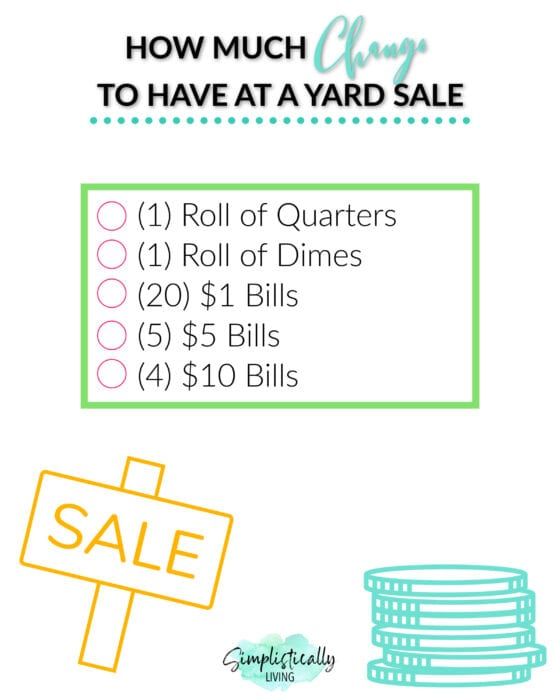
Here is the breakdown that works for 90 percent of USA sales. This mix was tested across sales in the Midwest, Southeast, and West Coast and it prevents the early-morning cash crunch.
The reason this amount works is simple math. If your average sale is $6 and three of your first five customers each pay with a $20 bill, you need $42 in change just for those three sales. Without small bills ready, you are stuck.

Why You Run Out of Change Fast in the USA
In the United States, garage sale shoppers follow a very predictable pattern. The serious buyers arrive at 6:30am to 7am, often with $20 bills fresh from an ATM. They want to buy quickly and move to the next sale. If you tell them you cannot break a $20 for a $1 item, they will leave your $1 item behind.
The second reason is pricing psychology. Many sellers price items at $3, $7, or $0.50. That means you constantly need $1s and quarters. If you price everything at $2, $5, $10, and $20, you will make change much more easily. This is a trick experienced sellers in Florida, Texas, and California use to reduce coin handling.
Another factor is that USA buyers rarely bring exact change on purpose. They bring large bills because they do not want to carry a pocket full of coins all day. Your job as the seller is to be the bank for them.
We also see a mid-morning rush between 9am and 11am when families arrive. This is when you get a lot of $5 and $10 sales for kids toys and clothes, all paid with $20s. If you used up all your small bills at 7am, you will have a problem at 10am.

How to Set Up Your Cash Box Like a Pro
You do not need to buy an expensive cash register. A simple lockable metal cash box from Walmart, Target, or Home Depot for $15 to $25 works perfectly. You can also use a carpenter apron, a fanny pack, or a small tackle box. The key is that your money is organized, visible to you, and never left unattended.
Before your sale, sort your bills by denomination facing the same way, largest on the bottom. Put coins in separate compartments or small plastic cups labeled quarters, dimes, nickels, pennies. This sounds basic, but when you have five people waiting, you do not want to hunt for a quarter.
Keep your starting bank separate from your profit during the sale. One simple method is to put your starting $150 in the box, and every time you hit $50 in profit, move that $50 into a separate envelope or zippered pouch in your pocket or inside your house. This way if someone does steal the box, you do not lose everything.
For safety in the USA, never leave your cash box on the table while you help someone carry furniture to their car. Take it with you or leave a trusted family member in charge. Also, do not flash large amounts of cash. Keep $50 and $100 bills you receive tucked under the tray.

Pricing Tricks That Reduce Your Need for Coins
One of the smartest things you can do is design your pricing to need less change. In the USA, buyers love simple prices. Use a color dot system instead of writing $0.47 on every item. For example, red dot equals $0.25, blue dot equals $1, green dot equals $5. Post a large sign explaining the colors.
Avoid pricing anything in pennies if you can. Price in $0.25 increments. Instead of $0.30, make it $0.25 or $0.50. Instead of $1.99, make it $2. You will save time, you will need fewer pennies, and buyers can add up their total faster.
Bundle small items. Instead of selling 20 baby onesies at $0.50 each and needing to make change 20 times, sell them as a bag of 5 for $2. This moves inventory faster and means one $5 bill covers it with simple change. The same works for books, DVDs, and kids toys.
For items over $20, round to the nearest $5. A coffee table for $27 is awkward. Make it $25 or $30. Buyers in the USA are more likely to pay $25 with a $20 and a $5 than to expect $3 back in ones.

Handling Electronic Payments and Large Bills
In 2026, cash is still king at USA garage sales, but more buyers now ask for Venmo, Cash App, Zelle, or PayPal. It is smart to have at least one option ready. Print a small QR code for your Venmo or Cash App and tape it to your cash box. Make sure your phone is charged and you have cell service in your driveway.
If you accept electronic payment, still require cash for anything under $5 to avoid fees and slowdowns. And always confirm the payment went through before handing over large items. Have the buyer show you the completed screen.
For large bills, set a personal rule before you start. Many experienced USA sellers do not accept $50 or $100 bills before 9am or for purchases under $15. Put a small sign that says We cannot accept bills over $20 before 9am or No $100 bills for sales under $20. This protects your small bill supply.
If someone wants to buy a $100 piece of furniture with a $100 bill, that is fine. You do not need change at all. The problem is only when someone buys a $2 item with a $100 bill at 7:05am. You are allowed to politely say, Do you have anything smaller? I just opened and I am low on change for large bills.
Keep a counterfeit pen from any office supply store in the USA if you plan to accept $50 and $100 bills. Quick swipe takes two seconds and protects you during busy sales.

Common Mistakes and Safety Tips for USA Sellers
The biggest mistake is bringing no change at all and assuming buyers will have exact change. They will not. The second biggest mistake is putting all your cash in one pile with no organization. When you are busy, you will give wrong change, and you will lose money or trust.
Another mistake is keeping all cash in one place outside. In the USA, garage sale theft is rare but it happens, especially when the box is left on a table near the sidewalk. Use a fanny pack or apron for your $1s, $5s, and quarters, and keep larger bills inside. Take turns with a partner for bathroom breaks so money is never alone.
Do not forget to have a plan for running out. Identify the nearest gas station or convenience store where you can quickly break a $20 if needed. Or ask a neighbor to be your backup bank for the morning. It is better to have a backup than to close early because you have no ones left.
Finally, track what sells and what does not. At the end of the day, count your coins. If you ended with zero quarters and 40 dimes, next time bring two rolls of quarters and fewer dimes. Your own data is the best teacher for your neighborhood and pricing style.