
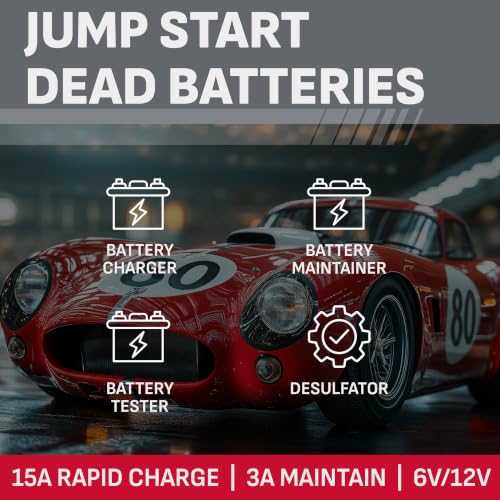
The best car battery charger for most drivers is the NOCO GENIUS10, thanks to its useful charging range.
You turn the key, hear a weak click, and realize your car will not start. Or your weekend car sits for weeks, and its battery loses charge between drives. A good battery charger can help with both problems, but the right choice depends on your battery and how you use your car. I favor smart chargers that match the battery type, control the charge, and switch to maintenance when needed. Below, I compare seven options, explain where each fits, and flag the limits that matter before you buy.
See the differences between my top picks at a glance.
| Product | Battery voltage | Listed output | Best fit | Main distinction | Shop |
|---|---|---|---|---|---|
| Schumacher SC1280 | 6V / 12V | 15A | Lead-acid car battery charging | Charger and maintainer | View on Amazon |
| TowerTop Smart Charger | 12V | 2A / 10A / 25A | Drivers who want current choices | Winter and repair modes | View on Amazon |
| NOCO GENIUS1 | 6V / 12V | 1A | Storage and small batteries | Low-current smart maintenance | View on Amazon |
| NOCO GENIUS10 | 6V / 12V | 10A | Most car owners | Charging and storage upkeep | View on Amazon |
| NOCO GENIUS5 | 6V / 12V | 5A | Patient home charging | Middle-ground output | View on Amazon |
| 12V/24V Heavy-Duty Charger | 12V / 24V | Advertised 0–20A range* | Mixed-voltage battery setups | Color screen and winter mode | View on Amazon |
| JOLTEKON Jump Starter | Confirm vehicle requirements | Advertised 4,500A peak jump current | Roadside starting and tire inflation | Jump starter, not a battery charger | View on Amazon |
*The heavy-duty model’s listed range does not establish its maximum output at each voltage. Check the exact manual before buying. Jump-start peak amps are not charging amps and cannot be compared directly.
Disclosure: I may earn a commission from qualifying purchases through these links. This guide compares available product information, not hands-on test results. Ratings are my editorial fit scores, not Amazon star ratings. I cannot verify current Amazon reviews, prices, or listing changes, so I do not present buyer comments as checked facts.
Schumacher SC1280 15A Battery Charger

The Schumacher SC1280 fits drivers who want more charging output than a small storage maintainer offers. Its listed 15A output gives it a useful role with compatible car batteries that need a real recharge. The unit supports 6V and 12V batteries and combines charging with maintenance. I see it as a garage tool rather than a roadside rescue device.
The key benefit is its focus on routine battery care without a long list of extra functions. Still, 15A is not the right rate for every battery, especially small motorcycle or lawn equipment batteries. Check the battery maker’s charge limit and the charger’s supported battery types before use. Do not assume it supports lithium batteries just because it can charge a 12V battery.
Pros:
- Supports both 6V and 12V battery systems.
- Listed 15A output suits more than light storage upkeep.
- Combines charging and maintenance in one unit.
- Fits home garages with more than one compatible vehicle.
- Offers a clear alternative to a slow 1A maintainer.
- Can serve drivers who prefer a dedicated charger over a mixed-use gadget.
Cons:
- Its charging rate may not suit small batteries.
- It does not replace a portable jump starter.
- You must confirm chemistry support for your exact battery.
What Amazon Buyers Are Saying
I cannot confirm current review patterns for the SC1280. Before you buy, look for recent, verified-purchase reviews that name the battery type and describe a full charge cycle. Reports about clamp grip, clear status lights, and the switch to maintenance will tell you more than a short “works great” comment. Also check whether complaints involve a failed battery, since a charger cannot fix every no-start fault.
My Recommendation
I would shortlist the SC1280 for a home garage that needs a 6V/12V charger with substantial output. It makes more sense for routine car battery charging than for keeping one small battery topped off. My overall fit rating is 4.1/5, based on its stated role and output. I would buy it only after checking the manual against the batteries I plan to charge.
| Category | Editorial rating |
|---|---|
| Car charging suitability | 4.5/5 |
| Voltage flexibility | 4.5/5 |
| Storage maintenance fit | 4/5 |
| Small-battery suitability | 3.5/5 |
| Overall fit | 4.1/5 |
TowerTop 2/10/25A Smart Battery Charger

The TowerTop stands out because it lists 2A, 10A, and 25A charge settings for 12V batteries. Those choices let you match the rate more closely to the battery, as long as its maker permits that rate. The listing names standard lead-acid, AGM, gel, and deep-cycle batteries. It also lists winter mode, repair functions, automatic maintenance, and engine-start assistance.
I like the range of options for a garage with several lead-acid batteries, but extra modes require care. A repair setting may help some sulfated batteries, yet it cannot fix a shorted cell or damaged case. Engine-start assistance is not the same as carrying a charged jump pack in your trunk. Read the mode rules closely, since the wrong charge profile can harm a battery or connected electronics.
Pros:
- Three listed current settings offer useful control.
- The 2A setting provides a lower-current option.
- The 25A setting may reduce bulk charging time on suitable batteries.
- Lists support for several common lead-acid battery types.
- Includes a winter mode for use under the manual’s stated conditions.
- Combines charging, maintenance, and added battery-care modes.
Cons:
- Supports 12V batteries, not 6V or 24V systems.
- More modes mean more chances to choose the wrong setting.
- Repair and start-assist labels do not promise battery recovery.
What Amazon Buyers Are Saying
I do not have a verified review set for this TowerTop model. I would look for detailed reports about mode selection, screen clarity, and whether the unit completes charging without repeated resets. Pay special attention to buyers using your battery type. A successful charge on a large flooded battery does not prove the same settings are safe for a small gel battery.
My Recommendation
I would choose this model over a basic maintainer when I need selectable current for several compatible 12V batteries. It is a strong fit for someone who will read the manual rather than treat every mode as a one-button fix. My overall fit rating is 4.2/5. Its appeal rests on current control, while its main limit is the lack of 6V and 24V support.
| Category | Editorial rating |
|---|---|
| Charge-rate choice | 4.5/5 |
| Listed lead-acid coverage | 4.5/5 |
| Maintenance features | 4.5/5 |
| Voltage flexibility | 3.5/5 |
| Overall fit | 4.2/5 |
NOCO GENIUS1 1A Smart Battery Charger

The NOCO GENIUS1 is the pick I would consider first for low-current storage care. Its 1A output suits small compatible batteries and patient charging far better than fast car battery recovery. It supports 6V and 12V lead-acid batteries, plus compatible 12V lithium batteries through the proper mode. Lithium use requires the type and battery management system specified in the manual.
A small charger can still be useful on a car that sits, provided the battery and maintenance limits match. The trade-off is time: a deeply discharged, full-size car battery can take far too long for an urgent need. I would not buy this unit as my only answer to frequent dead-battery mornings. For seasonal storage, though, low output is often a sensible fit rather than a flaw.
Pros:
- Low 1A output fits small-battery and storage tasks.
- Supports both 6V and 12V lead-acid batteries.
- Includes a mode for compatible 12V lithium batteries.
- Combines smart charging and maintenance.
- Offers a focused option when charging speed is not the goal.
- Can suit a second vehicle that spends long periods parked.
Cons:
- Very slow for recharging a depleted car battery.
- Not a jump starter or engine-start aid.
- Small output may not offset all ongoing vehicle power drains.
What Amazon Buyers Are Saying
I cannot verify current Amazon feedback for the GENIUS1. The most useful reviews would describe long-term storage, battery size, and the vehicle’s power draw while parked. Look for clear accounts of cable routing and status-light use, too. A complaint about slow charging may reflect a poor product match rather than a fault, since this is a 1A unit by design.
My Recommendation
I recommend the GENIUS1 for a compatible battery that mainly needs upkeep, not a quick refill. It could be the best car battery charger for a lightly used vehicle when speed has little value and the manual’s maintenance limits fit. My overall fit rating is 4.1/5 for that role. I would step up to the GENIUS5 or GENIUS10 for regular car battery recharging.
| Category | Editorial rating |
|---|---|
| Storage maintenance fit | 4.5/5 |
| Small-battery suitability | 4.5/5 |
| Voltage and mode flexibility | 4.5/5 |
| Full-size car recharge fit | 3/5 |
| Overall fit | 4.1/5 |
NOCO GENIUS10 10A Smart Battery Charger
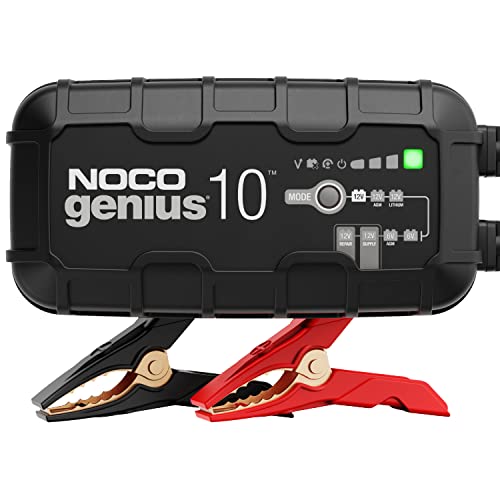
The NOCO GENIUS10 is my best car battery charger pick for most drivers who need both charging and upkeep. Its 10A output gives it more useful recharge capacity than the GENIUS1 or GENIUS5, subject to the battery’s allowed rate. It supports 6V and 12V lead-acid batteries, along with compatible 12V lithium batteries in the proper mode. That range suits many home garages without moving to a large shop charger.
Its appeal comes from balance, not from a claim that it will save every old battery. Smart charge control and temperature compensation help manage charging, but you still need to select the right mode. Special low-voltage or repair functions require close attention to the manual and the vehicle’s rules. I would treat those functions as tools for specific cases, not as routine steps on every charge.
Pros:
- 10A output offers a useful step up from small maintainers.
- Supports 6V and 12V lead-acid battery systems.
- Includes a dedicated mode for compatible 12V lithium batteries.
- Handles charging and maintenance with one unit.
- Temperature compensation helps account for changing conditions.
- Fits both occasional recharge work and seasonal storage care.
Cons:
- Does not support 24V battery systems.
- 10A may exceed the allowed rate for some small batteries.
- It cannot provide the instant roadside help of a jump pack.
What Amazon Buyers Are Saying
I cannot give a verified summary of current GENIUS10 customer reviews. When you check them, focus on reports that name the battery chemistry and explain how the charge ended. Useful details include clamp access, heat, error lights, and storage results over several weeks. Treat claims of “bringing any battery back to life” with care, since physical battery faults cannot be cured by a charge cycle.
My Recommendation
I would buy the GENIUS10 for a typical home garage with compatible car batteries that need more than light upkeep. It has the strongest all-around fit in this group, though a small battery owner may need less output. My overall fit rating is 4.6/5. It is worth shortlisting when its current price, battery support, and manual match your needs, rather than simply because it has the largest number in its name.
| Category | Editorial rating |
|---|---|
| General car charging fit | 4.5/5 |
| Voltage and chemistry flexibility | 4.5/5 |
| Storage maintenance fit | 5/5 |
| One-charger garage suitability | 4.5/5 |
| Overall fit | 4.6/5 |
NOCO GENIUS5 5A Smart Battery Charger

The NOCO GENIUS5 sits between slow storage charging and the stronger output of the GENIUS10. Its 5A rating makes sense for drivers who can leave a compatible battery to charge without a tight deadline. It supports 6V and 12V lead-acid batteries and compatible 12V lithium batteries with the correct mode. I see it as a balanced choice for light home use rather than frequent deep recharge work.
For a car that needs the odd top-up, extra charging speed may not justify a larger unit. The GENIUS5 keeps the smart charger and maintainer role while using a lower maximum current. That does not make it safe for every small battery, so check the allowed rate first. If your battery often goes flat, find the cause instead of making repeated charging part of your normal routine.
Pros:
- 5A output offers a middle ground for home charging.
- More capable of routine recharge work than a 1A unit.
- Supports both 6V and 12V lead-acid batteries.
- Provides a mode for compatible 12V lithium batteries.
- Combines maintenance with occasional battery charging.
- Can fit drivers who value flexibility more than speed.
Cons:
- Slower than the GENIUS10 on a suitable, equally depleted battery.
- Does not support 24V systems.
- May still be too much current for some small batteries.
What Amazon Buyers Are Saying
I cannot confirm current buyer review trends for the GENIUS5. I would check reviews from owners who use it for the same job you have in mind, such as winter storage or overnight top-ups. Look for battery size and starting charge level when buyers discuss speed. Without those details, a claim that it is “fast” or “slow” offers little help.
My Recommendation
I would choose the GENIUS5 when I want one smart charger for upkeep and occasional car charging, and I do not need the GENIUS10’s extra output. It may offer better value if the live price gap is large, but I cannot confirm that gap here. My overall fit rating is 4.4/5. For patient home use, it is a sensible contender for the best car battery charger.
| Category | Editorial rating |
|---|---|
| Occasional car charging fit | 4/5 |
| Voltage and chemistry flexibility | 4.5/5 |
| Storage maintenance fit | 4.5/5 |
| Balanced home-use suitability | 4.5/5 |
| Overall fit | 4.4/5 |
12V/24V 0–20A Heavy-Duty Battery Charger
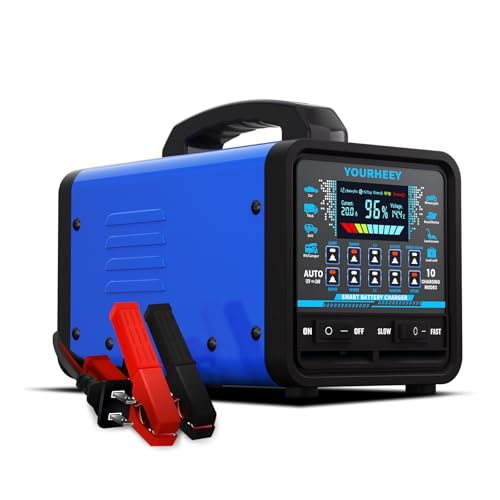
This listing targets buyers who need both 12V and 24V charging rather than the common 6V/12V range. It advertises a 0–20A range, automatic shutoff, repair and winter modes, ten modes, and a color screen. Those features could suit a mixed garage with cars and higher-voltage equipment. However, the supplied title does not identify a clear manufacturer or show the full output chart.
I would put document checks ahead of the feature count with this model. The “2026 upgraded” label does not prove better build quality, safer charging, or longer life. You need to confirm current at each voltage, supported battery types, charge limits, and what the shutoff function actually does. A clear manual and reachable seller support matter more than a long list of vehicles in the title.
Pros:
- Advertises both 12V and 24V battery support.
- Lists a broader current range than small maintainers.
- A color screen may make charge status easier to read.
- Includes an advertised winter mode.
- Lists automatic shutoff for charge control.
- Could cover mixed-voltage tasks if the manual confirms the fit.
Cons:
- Maximum current at each voltage is not clear from the title.
- The supplied listing lacks a clear manufacturer identity.
- Repair claims and the upgrade label need supporting detail.
What Amazon Buyers Are Saying
I cannot verify customer feedback for this exact listing. Check that reviews refer to the same model and version, not another item grouped under the same page. I would look for reports on actual 24V use, mode changes, support replies, and charge termination. Broad praise for the display does not settle the more important question of whether the unit charges your battery safely.
My Recommendation
I would consider this charger only when 24V support is a real need and the seller supplies a clear manual. For an ordinary 12V car, I would favor a model with better-defined specifications. My provisional overall fit rating is 3.1/5. This is not a measured quality score; it reflects the useful listed features alongside gaps that should be closed before purchase.
| Category | Editorial rating |
|---|---|
| Listed voltage flexibility | 4.5/5 |
| Listed mode range | 4/5 |
| Output specification clarity | 2/5 |
| Purchase confidence from supplied details | 2/5 |
| Overall fit, provisional | 3.1/5 |
JOLTEKON Jump Starter With Air Compressor
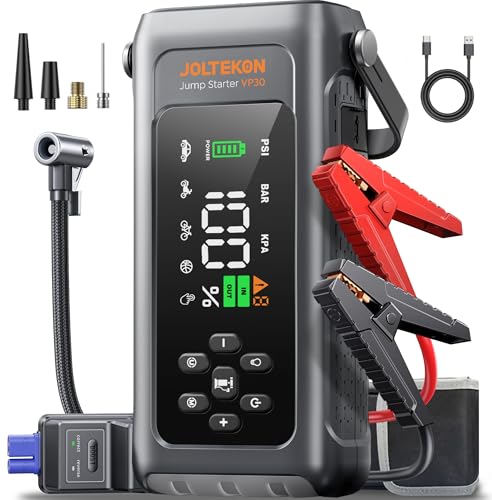
The JOLTEKON solves a different problem from the six plug-in chargers above. It is a portable jump starter with an air compressor, not a tool for fully recharging or maintaining your car battery. The listing advertises 4,500A peak starting current, a 150 PSI inflator, a light, and support claims for up to 9L gas or 8L diesel engines. I would treat those engine-size claims as advertised limits, not verified results in all weather.
Its main appeal is the chance to carry starting help and tire inflation in one device. The auto-shutoff inflator can be useful, but the 150 PSI figure is a maximum pressure claim, not a car tire pressure target. Use the pressure on the vehicle’s door placard and check the unit’s duty-cycle limits. You must also keep the jump pack charged, since a flat rescue device will not help when you need it.
Pros:
- Offers portable starting help away from an AC outlet.
- Combines a jump starter and tire inflator.
- Lists auto-shutoff for the inflator.
- Includes a light for low-light roadside tasks.
- Lists jumper cables as part of the package.
- Can complement a home charger as a separate emergency tool.
Cons:
- Does not fully recharge or maintain a car battery.
- Advertised peak amps do not establish sustained starting output.
- Starting and inflation depend on charge level, weather, and use limits.
What Amazon Buyers Are Saying
I cannot confirm current JOLTEKON buyer feedback. For this type of device, detailed cold-start reports matter more than praise about packaging or size. Check reviews for engine size, weather, jump-pack charge level, and how many starts the buyer tried. For the compressor, look for tire size, inflation time, pressure accuracy, and any need to stop for cooling.
My Recommendation
I would consider the JOLTEKON as an emergency companion to a home charger, not as the best car battery charger itself. It may suit drivers who want one portable tool for two roadside jobs, if the manual and recent reviews support their use case. My provisional overall emergency-tool fit rating is 3.6/5. Its value depends on verified starting ability and inflator performance, which I have not tested.
| Category | Editorial rating |
|---|---|
| Listed roadside feature coverage | 4.5/5 |
| Emergency-tool role suitability | 4/5 |
| Inflator feature usefulness | 4/5 |
| Performance certainty from supplied details | 2/5 |
| Overall emergency-tool fit, provisional | 3.6/5 |
How to Choose the Best Car Battery Charger
The best car battery charger is the one that matches your battery and your main task. A high amp rating alone does not make a charger better. I start with three checks: battery fit, charging speed, and safe day-to-day use. These checks also help you avoid paying for modes that you will never need.
1. Match the Voltage, Battery Type, and Charge Limit
Read the battery label before you shop. Most passenger cars use a 12V starting battery, but some older vehicles use 6V systems. Some trucks and equipment use 24V setups. Never choose the charger voltage by guesswork or by the size of the vehicle.
Next, check the battery type. A flooded lead-acid battery contains liquid electrolyte. AGM holds it in glass mats, while gel uses a gel form. These battery types can need different charge settings, even when all three say 12V on the case.
Lithium needs more care. A charger with an AGM mode is not automatically safe for lithium. Confirm the exact lithium type, voltage, and battery management system that the charger supports. Use both the battery manual and charger manual to settle the match.
I also check the maximum allowed charging current. A small battery can require far less current than a full-size car battery. More amps can mean less wait time, but only within the battery’s safe limits. If the manual leaves this unclear, ask the battery maker before you connect the charger.
For deeper background on charging stages and battery limits, consult the lead-acid charging guidance. Product-specific instructions still take priority for the battery and charger in front of you.
2. Choose Output for Recharging, Storage, or Roadside Help
A maintainer and a high-output charger serve different needs. If your car sits for weeks, smart maintenance may matter more than speed. If you often need to recharge a partly drained car battery, a 5A, 10A, or suitable higher-output charger can be more practical.
A simple time estimate helps put amps in context. If a battery needs about 30 amp-hours replaced, a 5A charger has an ideal bulk-charge estimate of six hours. A 10A charger gives an ideal estimate of three hours. Real charging takes longer because current tapers near full charge and some energy becomes heat.
Do not treat that math as a promise. Temperature, battery age, battery size, and the starting charge level all affect the result. A damaged battery may never accept a normal charge. Frequent discharge also calls for a battery test and a check for charging-system faults or unwanted power draw while parked.
For roadside help, choose a jump starter instead of expecting a wall-powered charger to do the job. A jump pack supplies a brief burst to crank the engine. A charger restores energy over time. Keeping both can make sense, but they are not interchangeable tools.
Deep-cycle use needs the same care. The words “RV” or “boat” in a title do not prove fit for every battery bank. Check bank voltage, battery chemistry, capacity, and any requirements for charging more than one battery.
3. Check Safety, Clear Instructions, and Long-Term Value
For me, clear instructions are part of product quality. I want a manual that explains supported batteries, error lights, charge modes, and maintenance limits. A readable screen helps, but it cannot make an unsafe mode choice safe. Repair modes deserve special care because some use voltage levels that may not suit connected vehicle electronics.
Never charge a frozen, leaking, swollen, cracked, or visibly damaged battery. Keep the area well ventilated, wear eye protection, and keep flames and sparks away. Lead-acid batteries can release explosive gas during charging. The battery-charging safety guidance explains why ventilation and spark control matter.
Follow your vehicle manual for connection points. Some cars use a remote positive terminal and a specified chassis ground so the battery sensor can track the charge. Connect and remove leads in the order given by the charger and vehicle makers. Do not assume every car should use the same clamp procedure.
I also compare cable reach, clamp access, storage space, return terms, and support. A low price loses its appeal if the leads cannot reach your battery or the seller cannot explain an error code. Check any claimed safety certification for the exact model rather than trusting a logo in a listing image.
Finally, a smart maintainer may suit long-term use only under the maker’s stated conditions. Keep the battery, plugs, and leads under regular watch. The best car battery charger should reduce hassle, not become a device you leave connected and never inspect.
Final Verdict: Which Should You Buy?
I recommend the NOCO GENIUS10 for most drivers with compatible batteries. Its 10A output and charging-plus-maintenance role give it the best overall fit. Choose the GENIUS5 for patient charging or GENIUS1 mainly for storage.
The best car battery charger matches your battery’s voltage, type, and safe charge rate. Check those first, and buy a jump starter separately if roadside starting help is your main need.
FAQs Of best car battery charger
What is the best car battery charger for most drivers?
The NOCO GENIUS10 is my top all-around pick for compatible car batteries. Its 10A output suits routine charging, and it also works as a maintainer. Check your battery’s voltage, type, and allowed charge rate before use.
Is a 5A or 10A car battery charger better?
A 10A charger can recharge a suitable battery faster than a 5A model. A 5A charger may be enough for patient home use. Choose a rate that does not exceed the battery maker’s limit.
Can I leave a smart battery charger connected overnight?
You can if the charger and battery manuals allow it and you use the correct mode. Follow all ventilation and placement rules. Do not leave a damaged battery or faulty charger connected.
Can a car battery charger fix a completely dead battery?
Some chargers can recharge a deeply discharged battery if it remains sound and meets their detection limits. They cannot fix a shorted cell, cracked case, or other physical damage. Have a battery tested if it will not hold a charge.
What is the difference between a battery charger and a jump starter?
A battery charger restores charge over time, usually with power from an outlet. A jump starter supplies a short burst to help crank the engine. A jump start does not fully recharge the car battery.